
Somalia’s Juridical Sovereignty and the Perils of an Evolving Post–Rules-Based Order
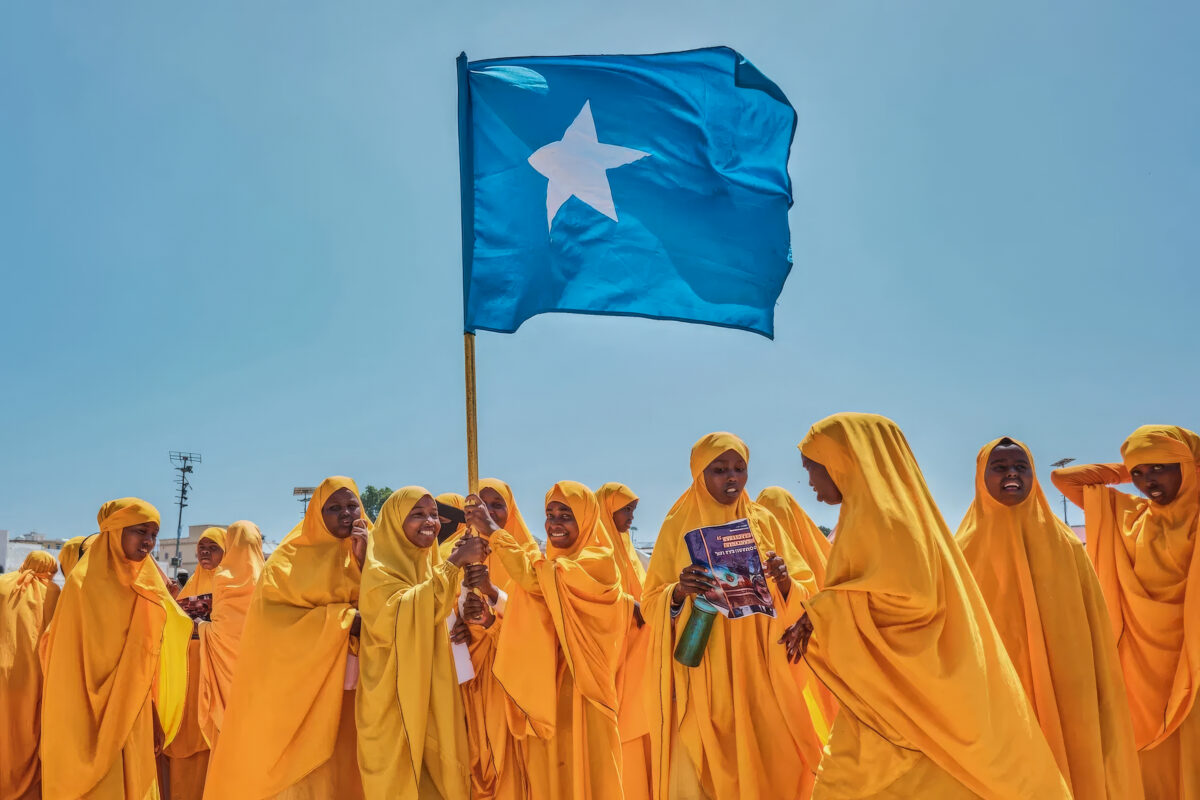
Students wave a Somali flag during a protest following the port deal signed between Ethiopia and Somaliland, in Mogadishu (AFP/Abdishukri Haybe)
When the central government collapsed in 1991, what collapsed was a short-lived era of statehood that had begun in 1960, following the end of colonial rule. This three-decade period can be divided into two phases: the civilian government, or First Republic (1960–1969), and the military government of the Second Republic (1969–1991). Both periods were characterized by the presence of empirical sovereignty and juridical sovereignty. The former refers to the Weberian definition of a state, based on the capacity of its national government to claim a monopoly over the use of force within its territory. The latter refers to the recognition of a state’s legitimacy by other states in the international system.
Despite the pan-Somali nationalist objective of achieving “Greater Somalia” – encompassing, in addition to the former British Somaliland Protectorate and Italian Somaliland Trust Territory, the Ogaden region of Ethiopia, present-day Djibouti, and Kenya’s Northern Frontier District – international law recognized only Somalia’s 1960 borders. One of the principal reasons successive Somali governments failed to realize their territorial ambitions was the protection that international law afforded existing states through the principle of territorial integrity. When the Organization of African Unity (now the African Union) was established in 1963, its member states affirmed the borders inherited at independence from colonial administrations and upheld the principle of state sovereignty within those borders.
When Somalia’s central government collapsed in 1991, this juridical sovereignty was largely upheld, despite the breakaway Somaliland, formerly a British Protectorate, declaring independence in May 1991 and despite foreign interventions during the height of the civil war. The rules-based order that upheld sovereignty and territorial integrity as inviolable, even if sometimes only rhetorically, now appears to be weakening. Recent developments, such as Ethiopia’s signing of a maritime agreement with the breakaway Somaliland region on sea access in violation of Somalia’s sovereignty and territorial integrity, and Israel’s recognition of Somaliland as an independent state, suggest that the international rules-based order is under strain and that juridical sovereignty alone may no longer be sufficient.
State Legitimacy and the Social Contract
Years of civil war have eroded state legitimacy, the public acceptance that the state has the right to rule through a social contract by maintaining order and providing public services in a fair and transparent manner. This is not to suggest that the state enjoyed strong legitimacy before the civil war. Public services were concentrated in Mogadishu and major urban centers such as Kismayo, Hargeisa, and Baidoa, while access in rural areas remained limited. Nevertheless, the state possessed empirical sovereignty and largely maintained a monopoly over the use of force.
While the military regime successfully consolidated state authority, expanded public services, and established a social contract in which citizens were willing to cede certain liberties in exchange for security and state provision, it was ultimately an authoritarian social contract. The regime proved unable to sustain it as financial pressures mounted and internal dissent intensified following the Ogaden War.
With the formation of the Third Republic following the 2000 Arta Peace Conference, and the end of the transitional period in 2012 that led to the establishment of the Federal Government of Somalia (FGS), significant progress has been made toward peace and stability. However, consolidating statehood and empirical sovereignty requires more than these gains. It requires the state to build legitimacy and exercise authority across all territories under its jurisdiction. This cannot be achieved if state institutions remain weak, constitutional crises persist, electoral impasses recur, relations between the center and the periphery remain strained, dependence on external aid continues, and the state remains unable to defend the country from foreign interference.
More Divided Than United
The quest for national unity in Somalia has undergone several transformations, from the struggle for independence, to the pursuit of Greater Somalia, to separatism, and ultimately to a federal system that, in some respects, has weakened the state more than it has enhanced political balance, service delivery, and power sharing. While Somalis from the 1960s through the 1980s may have disagreed on whether the state enjoyed legitimacy or upheld a genuine social contract, there was broad loyalty to a unified Somali state that possessed both empirical and juridical sovereignty.
Notably, the period during which Somalia’s 1960 borders were perceived to be unified under a single authority and flag lasted less than 31 years. In contrast, the post–civil war period – marked by fragmentation and contested authority – has now extended to 35 years. In other words, the collective memory of a unified Somali state is now shorter than the lived experience of a divided one. This temporal shift has profound implications for how legitimacy, authority, and national identity are understood across generations, and it will likely continue shaping and reshaping state-building processes in Somalia over the long term.
In contrast, those born after 1991 – who constitute approximately 80 percent of the population – often hold differing perceptions of what the Somali nation represents, the subnational identities that have emerged since, and the meaning of state legitimacy and the social contract. Swathes of territory also remain under al-Shabaab control, with segments of the population – particularly youth in these areas – having experienced no form of governance other than that of the insurgent group.
In an evolving post–rules-based international order, acquiring both legitimacy and empirical sovereignty will be critical if the Somalia envisioned in 1960 is to endure. Somalia’s continued reliance on juridical sovereignty – international recognition without fully consolidated internal authority – may prove increasingly precarious in a global environment where power, strategic interests, and state capacity are becoming more central than normative commitments to sovereignty and territorial integrity.
As the institutions and norms that have historically sustained the post–Cold War order gradually weaken, the international system is increasingly reverting toward a ‘self-help’ environment in which states rely primarily on their own institutional resilience, economic strength, and security capabilities to survive. At this critical juncture, Somalia cannot afford to remain politically fragmented, institutionally weak, and structurally dependent on external assistance. Its long-term survival as a unified state will depend not only on international recognition, but also on its ability to rebuild internal legitimacy, strengthen governance institutions, and consolidate empirical sovereignty.
Author: Ibrahim Mukhtar, Researcher and Program Coordinator, Heritage Institute for Policy Studies.
Disclaimer: This blog reflects the views of the author and not those of the Heritage Institute for Policy Studies.
- Category: Blogs
- Tag: Empirical Sovereignty, Juridical Sovereignty, Social Contract, State Legitimacy